Chapter 1The language and its speakers
Sakhalin Ainu and its names, its speakers and their history, language contact, endangerment, and documentation.
Sakhalin Ainu is the variety of Ainu once spoken across the southern half of Sakhalin island. Together with Hokkaidō Ainu and Kuril Ainu it forms one of the three major branches of the small Ainu language family (Janhunen 2022). The language ceased to be passed on to children in the first half of the twentieth century and lost its last native speaker in 1994 (Dal Corso 2024: 55, 58), so that everything we know of it rests on a documentary record stretching from the 1860s to the 1990s. This chapter introduces the language and its speakers; Chapter 2 surveys the dialects and the sources in detail.
1.1 Names of the language and its speakers
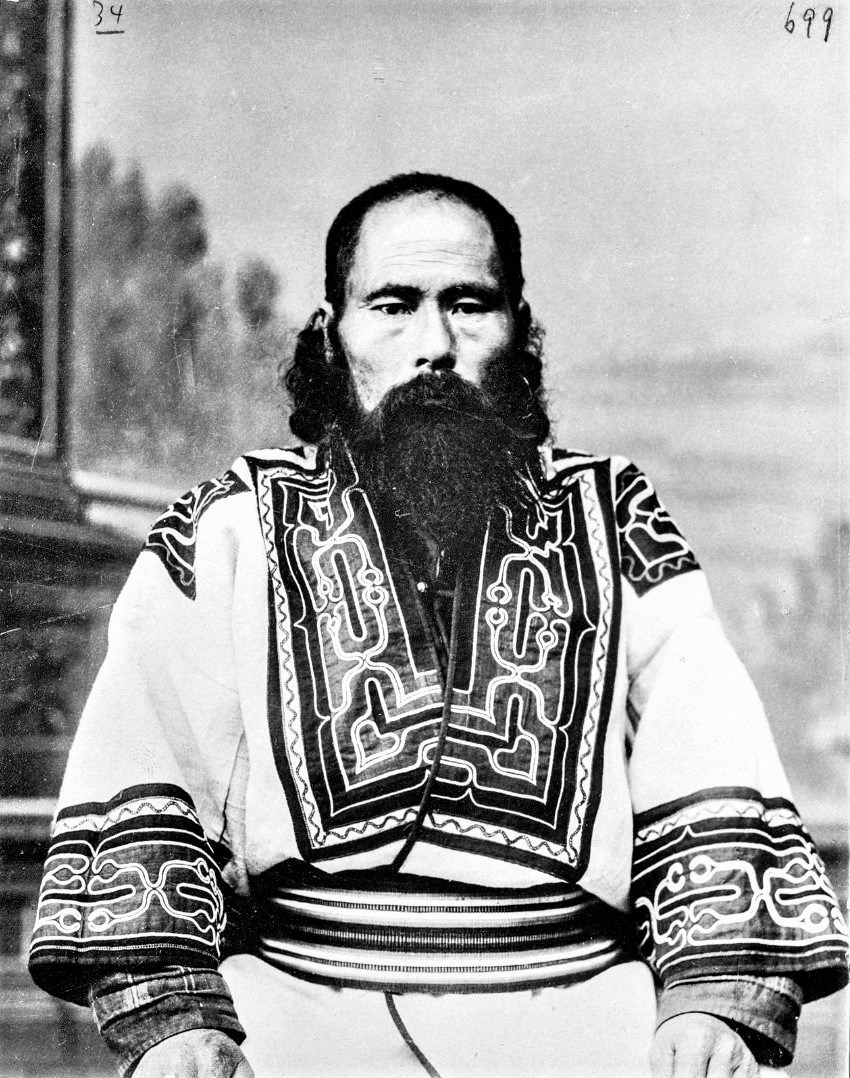
The name Ainu is the word aynu ‘human being, person’, which in opposition to other ethnonyms and to the gods denotes members of the Ainu people; the word was in use in this sense among all regional groups, including those of Sakhalin (Janhunen 2022), (Hattori 1964: 34). Sakhalin speakers applied it to themselves in ordinary discourse: writing to Bronisław Piłsudski in 1906, Sentoku Tarōji 千徳太郎治 — himself a Sakhalin Ainu, who would later publish 樺太アイヌ叢話, one of the earliest accounts of the community written from within it (Sentoku 1929) — reports on his community as follows.
Alongside aynu, Sakhalin Ainu has a second word for ‘human being’ with no counterpart in Hokkaidō: enciw ‘human being’, recorded by Chiri (1942: §2) in the form enciw among words showing voicing after a nasal, and used historically as a self-designation by the Sakhalin Ainu (Dal Corso 2024: 55). The modern descendants of the Sakhalin Ainu have adopted enciw as the label that distinguishes them from the Hokkaidō Ainu (Janhunen 2022), and in today’s revival movement the language is called Enciw itah ‘language of the Enciw’ (Dal Corso 2024: 55), a usage also followed by (Murasaki 2025).
The second element of that name, itah ‘speech, language’, is the Sakhalin form corresponding to Hokkaidō itak, with the regular Sakhalin coda neutralisation described in Chapter 4. It is an old element of the language’s own metalinguistic vocabulary: the title page of the first dictionary of the language renders ‘Ainu–Russian dictionary’ in Cyrillic-script Ainu as а́йну-ру́сскій ита́ку-чо́менъ, with itaku for ‘word, speech’ (Dobrotvorsky 1875). In the scholarly literature the variety is most often called Sakhalin Ainu in English and 樺太アイヌ語 Karafuto ainugo ‘Karafuto Ainu’ in Japanese, after the Japanese name of the island (Dal Corso 2024: 57); both names are used of the same object, and this grammar writes Sakhalin Ainu.
1.2 Geographic setting and history
The Ainu settlement area on Sakhalin covered the southern part of the island, from Aniwa Bay in the south up both coasts to roughly the 50th parallel. Archaeological evidence places the Ainu expansion from Hokkaidō onto southern Sakhalin at about 1300 CE (Janhunen 2022). On the west coast, facing the Strait of Tartary, lay villages such as Tarantomari 多蘭泊 (now Калинино), Maoka 真岡 (now Kholmsk), Rayciska 来知志 (now Красногорск), Odasu 小田洲 (now Парусное), Usoro 鵜城, and Esutoru 恵須取 (now Углегорск); on the east coast, facing the Sea of Okhotsk, Ociho 落帆, Tunayci 富内, Ay, Otasan 小田寒, Hunup, and, on the Bay of Patience in the north-east, Tarayka 多来加 and Nairo 内路 (Tangiku 2022), (Ono 2020: 232), (Dal Corso 2024: 58). The Poronay basin behind Tarayka was the zone where the Ainu were in community-level contact with the Uilta and the Nivkh, their only ethnic neighbours on the island apart from Japanese and Russians (Janhunen 2022) (see §1.4).
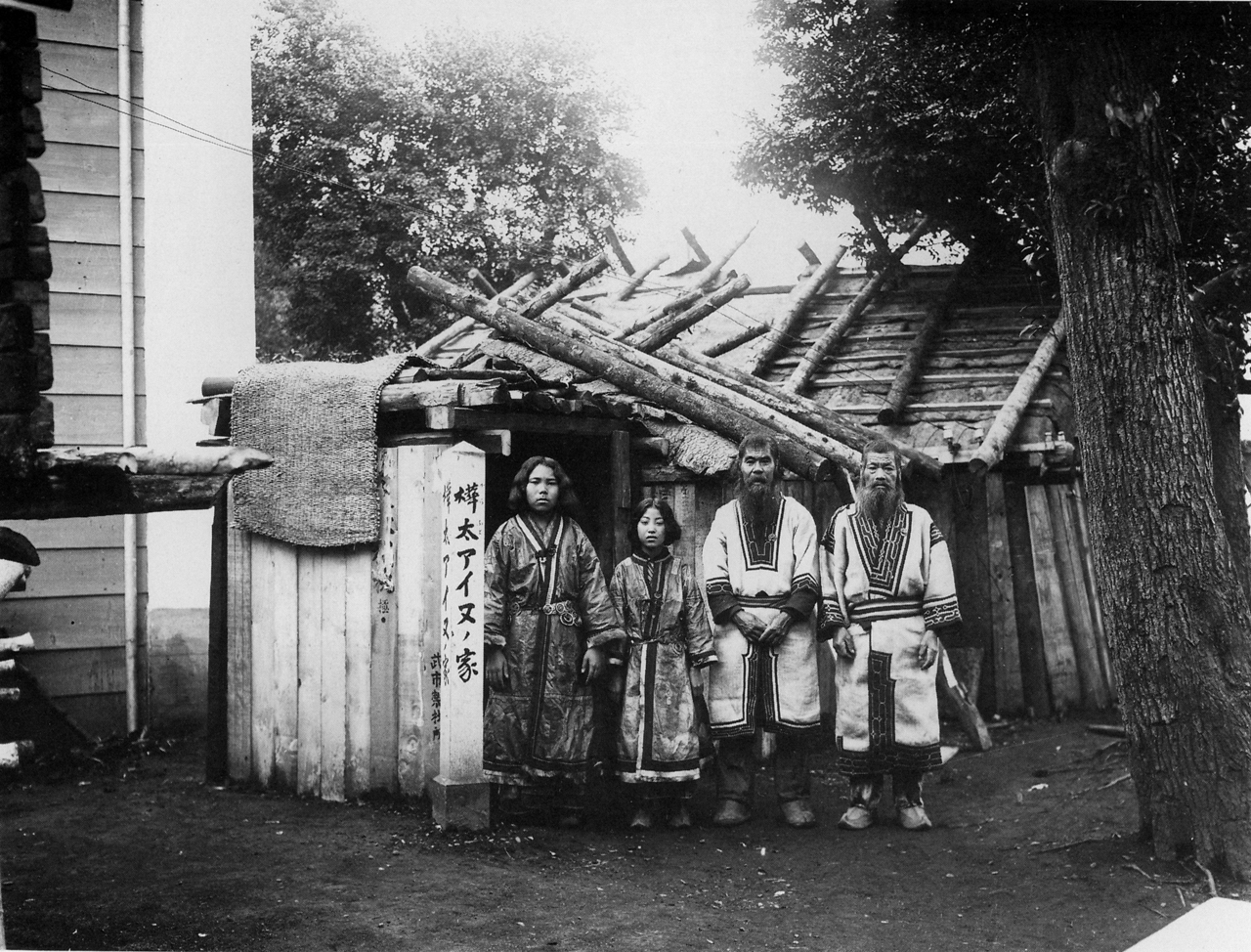
Both colonial powers reshaped Ainu life on Sakhalin in the nineteenth century. Japanese fisheries operated along the coasts, with Ainu working in and later running them (Piłsudski 1912: X), while Russia ran the island as a penal colony; it was as a military physician in this colony, in 1867–1872, that Mikhail M. Dobrotvorsky Михаил Михайлович Добротворский made the first substantial record of the language (Sakaguchi 2021: 43). By the Treaty of Saint Petersburg of 1875 the whole island passed to Russia, and 841 Ainu of the Aniwa Bay area were moved to Sōya in northernmost Hokkaidō and then, against their declared wishes, resettled by the colonial administration at Tsuishikari 対雁 near Sapporo. Cholera and smallpox epidemics in 1879 and 1886–1887 killed about half of them; survivors began returning to Sakhalin around 1890, and after the island’s southern half became the Japanese territory of Karafuto 樺太 in 1905 nearly all of the Tsuishikari community went home (Sakaguchi 2024: 7–8).
At the start of the Karafuto period (1905–1945) the Sakhalin Ainu numbered about 2,000, and nearly all of them spoke the language (Tangiku 2022); Piłsudski (1912: V) put the entire Ainu population of Hokkaidō, Sakhalin, and Shikotan at about 20,000 at the same date. Japanese assimilation policy discouraged the use of Ainu and pressed a Japanese lifestyle on the community, and transmission to children broke off in the first half of the twentieth century (Dal Corso 2024: 57). Small, mainly Ainu hamlets nevertheless persisted on Karafuto until the end of the Second World War, and several hundred speakers are estimated to have remained in 1945 (Tangiku 2022). When southern Sakhalin reverted to the Soviet Union after the war, almost the whole Ainu population, holding Japanese citizenship, was evacuated to Hokkaidō and points south by 1948 and dispersed there; only a small number stayed behind in Russia (Sakaguchi 2024: 8), (Dal Corso 2024: 57).
The fluent speakers known to post-war research were all evacuees living in Hokkaidō. The two whose speech is best documented are Fujiyama Haru 藤山ハル (1900–1974), raised in Esutoru and long resident in Rayciska, who was found through the dialect survey of the 1950s living at Tokoro in eastern Hokkaidō (Tangiku 2022), (Sakaguchi 2024: 8), and Asai Take 浅井タケ (1902–1994) of Odasu (Tangiku 2022). With Asai Take’s death in 1994 the language lost its last native speaker (Dal Corso 2024: 55, 58).
1.3 Genetic affiliation and typological profile
Ainu has no demonstrated relatives. Proposals linking it to “Altaic”, Japanese, Nivkh, and other languages have not withstood scrutiny (Shibatani 1990: 5–7), (Vovin 1993), so Ainu is either an isolate or, given its considerable internal diversity, a small family of three closely related languages corresponding to the Hokkaidō, Sakhalin, and Northern Kuril groups (Janhunen 2022). The position of Sakhalin Ainu as a primary branch is supported quantitatively: in the lexicostatistical survey conducted by Hattori Shirō 服部四郎 and Chiri Mashiho 知里真志保 in the 1950s, the cluster analysis of Asai (1974: 100) set the Sakhalin dialects apart from both Hokkaidō and North Kuril as one of three top-level groups, and the statistical reanalysis of Ono (2020) yields an even sharper picture in which the deepest split in the family runs between the Sakhalin dialects and everything else. A Bayesian phylogeographic analysis of the same Hattori–Chiri wordlists — which sample the Hokkaidō and Sakhalin dialects but not Kuril — likewise splits them into a Sakhalin and a Hokkaidō subgroup and traces their spread from a homeland in northern Hokkaidō (Lee & Hasegawa 2013). Sakhalin Ainu separates from Hokkaidō Ainu by regular phonological correspondences and by its own grammatical retentions and innovations; Vovin (1993) draws on Sakhalin evidence, including the Nairo dialect, throughout his reconstruction of Proto-Ainu. The internal division of Sakhalin Ainu is treated in Chapter 2.
Typologically, Sakhalin Ainu is a polysynthetic, agglutinating, strongly head-marking language with verb-final order: intransitive clauses are SV and transitive clauses AOV (Dal Corso 2024: 56). Adpositions follow their complement (Chapter 11), and modifiers precede their head. Personal prefixes and clitics on the verb index the core arguments, in a mixed alignment system that includes the indefinite set an-, -an, i- discussed in Chapter 13 (Dal Corso 2025a). Nouns distinguish a plain and a possessed (“belonging”) form, and the possessive suffix has a wider range in Sakhalin than in Hokkaidō, extending into the nominalisation of verbs (Chapter 7, Chapter 20) (Bugaeva 2016), (Tangiku 2022). The phonology has five vowels with a length contrast and a coda system in which the stops of Hokkaidō Ainu are neutralised to h (Chapter 4) (Tangiku 2022), (Itabashi 2001). There is no tense morphology; mood, aspect, and evidentiality are expressed by synthetic and analytic means (Dal Corso 2024: 56), among them the reportative manu that recurs at the end of narrative sentences throughout the folktale corpus (Chapter 16) (Dal Corso 2018):
Numerals are built on a base of twenty, hoh ‘twenty’, with vigesimal counting amply attested in the nineteenth-century record; alongside it the Sakhalin sources show borrowed decimal bases such as tanku ‘hundred’ and wantanku ‘thousand’, and decimal counting gained ground over the period of documentation (Chapter 10) (Sakaguchi 2022), (Murasaki 2009). Negation is analytic, with preverbal negators such as hannehka that developed within Sakhalin Ainu (Chapter 17) (Dal Corso 2021), (Dal Corso 2025b).
1.4 Language contact
On Sakhalin the Ainu bordered on the Uilta (Orok), speakers of a Tungusic language, and the Nivkh, speakers of another isolate; the principal contact area was the Poronay basin and the Tarayka region in the north-east, with a second mixed zone on the northern west coast (Janhunen 2022), (Shiraishi & Tangiku 2022), (Gruzdeva 1996). Japanese travel records of the late eighteenth and nineteenth centuries show that multilingualism was limited and localised rather than general: in contact situations around Lake Tarayka it was usually the Uilta who spoke Ainu, while command of Ainu among the Nivkh was restricted to particular individuals (Shiraishi & Tangiku 2022).
Lexical borrowing nevertheless ran in both directions. Sakhalin Ainu took over dog-sled vocabulary from Nivkh, including nuso ‘dog sled’ (also nuhsu) from Nivkh nuci — an etymology going back to Chiri — and shows pairs such as muhru ‘pillow’ beside Nivkh mut with the regular r-for-t correspondence of loans between the two languages (Shiraishi & Tangiku 2022). From Uilta the west-coast dialects took wampakka ‘mittens’, where the east coast uses matumere (Shiraishi & Tangiku 2022). Older strata of contact include tunakay ‘reindeer’, connected with the Nivkh (Ghilyak) word for the pulling animal, and the early Japonic loans sippo ‘salt’ and pasuy ‘chopsticks’, which entered Ainu as a whole well before the historical period (Janhunen 2022). The decimal numeral bases mentioned in §1.3 are likewise borrowings (Sakaguchi 2022: 67–68).
Japanese supplied the names of trade goods that reached the Ainu from the south, for example hasami ‘scissors’ and konkaani ‘gold, metal’ (Shiraishi & Tangiku 2022), and during the Karafuto period it became the dominant contact language altogether; the post-war recordings of Asai Take contain frequent Japanese asides and code-switches around an Ainu grammatical core (Murasaki 2001). Russian left a lighter mark on the lexicon, but a distinctive one on writing: pupils of the school Piłsudski ran on the east coast learned to write their own language in Russian characters (Piłsudski 1912: XII), and Sentoku Tarōji’s Cyrillic-script letters of 1906 — see (1) — are the chief monument of this practice (Tangiku & Ogihara 2001) (on script, see Chapter 3). The Russians themselves appear in the letters under the Ainu name nuca ‘Russian’.
1.5 Endangerment and present-day status
Sakhalin Ainu is today a dormant language: natural transmission ended in the first half of the twentieth century, and no native speaker has lived since 1994 (Dal Corso 2024: 55, 57), (Janhunen 2022); the UNESCO Atlas of the World’s Languages in Danger accordingly records Sakhalin Ainu among the languages that have become extinct since they were linguistically described (UNESCO 2010). It is not, however, an unused one. Descendants of the Sakhalin Ainu in Japan study and revive the language under the name Enciw itah, with the scholar and activist Kitahara Jirōta Mokottunas 北原次郎太 among those leading the effort (Dal Corso 2024: 55), and teaching materials now exist, including the conversation course of Murasaki (2025). The recorded legacy is substantial: Piłsudski’s wax-cylinder recordings of the Ainu, made in 1902–1903, have been partly restored from the 1980s onward by a laser-beam reflection method developed for the purpose (Iwai et al. 1987), (Dal Corso 2024: 59), and the post-war tape recordings of Fujiyama Haru and Asai Take were published with audio (Murasaki 2001), (Tangiku 2022).
This grammar is one part of that documentation-based revival. It is published beside a dictionary of Sakhalin Ainu on this site, and every Ainu word and morpheme in the examples is linked to the dictionary so that the attested record, rather than any modern reconstruction, remains the point of reference throughout. The sources on which the description rests are set out in Chapter 2.